

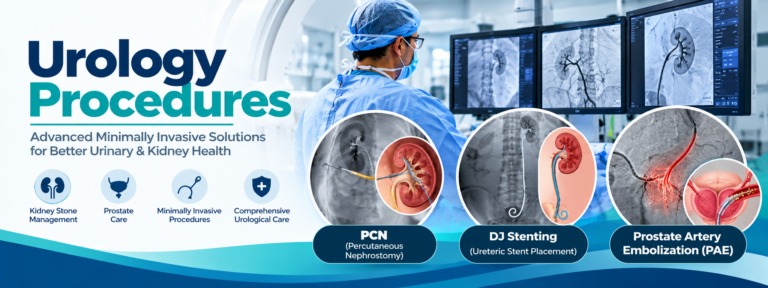
Interventional Radiology provides a range of minimally invasive, image-guided procedures for selected urological conditions. These procedures use advanced imaging techniques such as ultrasound, CT, fluoroscopy and X-ray guidance to accurately access the urinary system and treat problems involving the kidneys, ureters and bladder.
Image-guided urological interventions may be considered for urinary obstruction, kidney stones, urinary leakage, selected renal conditions and other situations where a minimally invasive approach can provide effective drainage or treatment. These procedures may be performed as an alternative to, or in coordination with, conventional surgical treatment depending on the patient’s condition.
Percutaneous Nephrostomy (PCN)
Percutaneous nephrostomy is a minimally invasive procedure used to drain urine directly from the kidney when normal urine flow through the ureter is blocked.
Under ultrasound and/or X-ray guidance, a thin catheter is inserted through the skin into the kidney’s collecting system. The catheter allows urine to drain into an external collection bag and can help relieve pressure within the kidney.
Common indications include:
- Ureteric or urinary tract obstruction
- Obstruction caused by kidney or ureteric stones
- Malignant urinary obstruction
- Severe hydronephrosis
- Selected postoperative or inflammatory strictures
- Infected obstructed urinary system
Prompt drainage may be particularly important when obstruction is associated with infection.
Ureteric Obstruction & Urinary Drainage
Blockage of the ureter can prevent urine from passing normally from the kidney to the bladder. Image-guided drainage can help restore urinary drainage and protect kidney function in selected patients.
Depending on the location and cause of the obstruction, procedures may include percutaneous nephrostomy, antegrade ureteric interventions or stent-related procedures.
The treatment approach is selected based on imaging findings, renal function, the cause of obstruction and the patient’s overall condition.
Antegrade Ureteric Stenting
In selected patients with ureteric obstruction, an internal ureteric stent may be placed through a percutaneous access route from the kidney.
The stent helps maintain a pathway for urine to flow from the kidney towards the bladder. This approach may be considered when conventional retrograde stent placement is difficult or unsuccessful.
Kidney Stone–Related Interventions
Certain kidney stones, particularly large, complex or obstructing stones, may require image-guided access to the urinary collecting system.
Interventional Radiology can assist with percutaneous renal access in selected cases, including access used for procedures such as percutaneous nephrolithotomy (PCNL). Imaging helps establish a safe pathway to the kidney while avoiding surrounding organs and structures.
Treatment decisions depend on the size, number and location of stones, urinary obstruction, kidney anatomy and overall patient condition.
Nephrostomy Tube Exchange & Management
Patients who require longer-term nephrostomy drainage may need periodic catheter evaluation, exchange or repositioning.
Image guidance helps confirm catheter position and allows the interventional radiologist to safely replace or adjust the drainage catheter when required.
This can be particularly important in patients with persistent urinary obstruction or long-term urinary drainage requirements.
Urinary Leak Management
Urinary leakage can occur following surgery, trauma or certain urological procedures. In selected cases, image-guided drainage or urinary diversion may help control the leak and allow the affected area to heal.
Depending on the location and severity of the leak, treatment may involve nephrostomy drainage, collection drainage or other image-guided interventions, often in coordination with the urology team.
Drainage of Perinephric & Urinary Collections
Fluid or infected collections can occasionally develop around the kidney or within the urinary tract following infection, surgery, trauma or other conditions.
CT- or ultrasound-guided percutaneous drainage can provide a minimally invasive method of accessing and draining selected collections. A catheter may be left temporarily to allow continued drainage while the underlying condition is treated.
Image-Guided Renal Biopsy
Image-guided renal biopsy allows a small tissue sample to be obtained from the kidney using a specialised needle under ultrasound or CT guidance.
The procedure may be recommended when tissue diagnosis is required to evaluate selected kidney diseases or lesions. Imaging guidance helps accurately target the required area while reducing the risk of injury to surrounding structures.
Image-Guided Treatment of Selected Renal Lesions
Selected kidney lesions may be evaluated and, in appropriate patients, treated using minimally invasive image-guided techniques.
Depending on the lesion and clinical situation, thermal ablation techniques such as radiofrequency ablation or microwave ablation may be considered for selected renal tumours. Patient selection is based on tumour size, location, kidney function, overall health and other treatment options.
Key Benefits
- Minimally invasive, image-guided approach
- Precise access to the urinary system
- Small skin entry point for many procedures
- Can provide rapid relief of urinary obstruction
- May help preserve kidney function in selected obstructive conditions
- Reduced tissue trauma compared with open surgical procedures
- Can be performed in patients who may not be suitable for major surgery
- Procedures can be planned in coordination with urologists and other specialists
When May Urological Interventions Be Considered?
Interventional Radiology procedures may be considered for selected patients with:
- Urinary tract obstruction
- Hydronephrosis
- Kidney or ureteric stones
- Malignant urinary obstruction
- Urinary leaks
- Perinephric or urinary collections
- Selected renal lesions
- Need for long-term nephrostomy drainage
- Selected postoperative urological complications
Multidisciplinary Urological Care
Urological interventions are planned according to the patient’s symptoms, kidney function, laboratory results, imaging findings and underlying cause.
The Interventional Radiologist works closely with urologists, nephrologists, oncologists and surgeons when required to determine the most appropriate treatment strategy.
The goal is to provide safe, precise and minimally invasive treatment while addressing the underlying condition and preserving kidney and urinary tract function whenever possible.
Procedures Offered May Include
- Percutaneous Nephrostomy (PCN)
- Nephrostomy Tube Exchange & Management
- Antegrade Ureteric Stenting
- Percutaneous Renal Access for Selected Stone Procedures
- Drainage of Urinary & Perinephric Collections
- Management of Selected Urinary Leaks
- Image-Guided Renal Biopsy
- Image-Guided Renal Tumour Ablation
- Management of Selected Urinary Obstructions
- Other Image-Guided Urological Interventions
Important: Not every urological condition requires an interventional procedure. The most appropriate treatment depends on the patient’s individual anatomy, diagnosis, imaging findings, kidney function and overall health. A detailed clinical and imaging assessment is performed before recommending any procedure.