

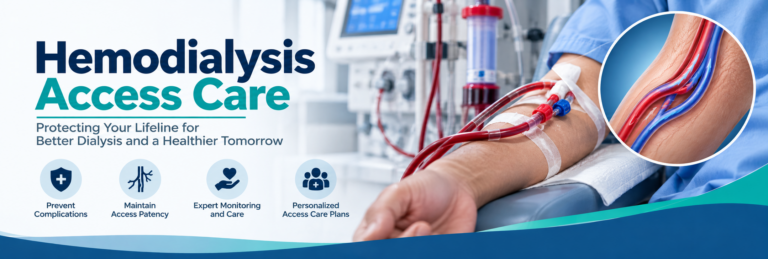
A well-functioning vascular access is essential for patients undergoing haemodialysis. An arteriovenous (AV) fistula or AV graft provides reliable access to the bloodstream so that blood can be removed, filtered and returned during dialysis. Over time, the access may develop narrowing (stenosis), blood clots, reduced blood flow or other complications, which can affect the effectiveness of dialysis and may eventually lead to access failure.
Interventional Radiology provides minimally invasive, image-guided procedures to evaluate and treat many dialysis access problems. These treatments are designed to restore or improve blood flow, maintain access function and help extend the useful life of the vascular access.
Common Dialysis Access Problems
Dialysis access can develop problems gradually or suddenly. Common issues include:
- Stenosis (narrowing): Narrowing of the blood vessel can reduce blood flow through the fistula or graft.
- Thrombosis (blood clot): A clot may completely or partially block the access and prevent effective dialysis.
- Poor blood flow: Reduced flow may result in inadequate dialysis or difficulty using the access.
- Access dysfunction: Problems such as difficulty inserting dialysis needles or changes in dialysis machine pressures may indicate an underlying access problem.
- Aneurysm or pseudoaneurysm: Enlargement or weakening of part of the access may require evaluation and treatment.
- Other access-related complications: Swelling, prolonged bleeding after dialysis or changes in the appearance or function of the access may require assessment.
How Is Hemodialysis Access Evaluated?
The vascular access is assessed using clinical examination and appropriate imaging. In selected patients, a catheter-based angiographic examination, known as a fistulogram or access angiogram, may be performed to identify areas of narrowing, blockage or other abnormalities.
If a treatable narrowing or blockage is identified, an appropriate endovascular procedure may be performed during the same session, depending on the patient’s condition and the type of access problem.
Treatment Options-
Angioplasty
Balloon angioplasty is commonly used to treat narrowed portions of an AV fistula or graft. A small catheter with a balloon is guided to the narrowed area under imaging guidance. The balloon is inflated carefully to widen the narrowed segment and improve blood flow.
Thrombectomy / Thrombus Treatment
When an AV fistula or graft becomes blocked by a blood clot, catheter-based techniques may be used in selected patients to remove or treat the clot and restore access flow. Additional treatment may be required if an underlying narrowing is responsible for the clot formation.
Other Endovascular Treatments
Depending on the location and severity of the problem, additional catheter-based techniques or devices may be considered. Treatment is individualized based on the type of dialysis access, imaging findings and the patient’s overall condition.
Benefits of Interventional Radiology Treatment
- Minimally invasive, catheter-based approach
- Image-guided diagnosis and treatment
- Can help restore or improve blood flow
- May help preserve the existing dialysis access
- Can address certain problems without open surgery
- May allow patients to continue using their established vascular access
When Should You Seek Evaluation?
Patients undergoing haemodialysis should inform their dialysis team or doctor if they notice:
- Reduced or absent thrill or vibration over the fistula
- Difficulty achieving adequate dialysis blood flow
- Repeated high or low pressure alarms during dialysis
- Difficulty inserting dialysis needles
- Prolonged bleeding after needle removal
- Increasing swelling or pain around the access
- Sudden changes in the appearance or function of the fistula or graft
Early evaluation of access dysfunction may help identify problems before the access becomes completely blocked.
Our Approach
Hemodialysis access procedures are performed using advanced imaging guidance to accurately identify the underlying problem and provide appropriate minimally invasive treatment. The choice of procedure depends on the type of vascular access, location and severity of the narrowing or blockage, and the patient’s individual medical condition.
Early diagnosis and timely treatment can help preserve vascular access and support effective, uninterrupted haemodialysis.