
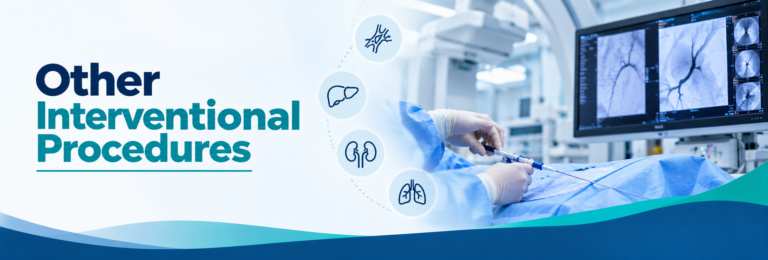
Interventional Radiology offers a wide range of minimally invasive, image-guided procedures for conditions that may require targeted treatment, drainage, biopsy, vascular access or symptom management. These procedures use advanced imaging such as ultrasound, CT, fluoroscopy and angiography to guide specialised needles, catheters and other instruments with precision.
These interventions can provide treatment through a small skin puncture rather than conventional open surgery in selected patients. The choice of procedure depends on the patient’s diagnosis, anatomy, imaging findings, overall health and previous treatments.
Image-Guided Biopsy
Image-guided biopsy is a minimally invasive procedure used to obtain a tissue sample from a suspicious lesion or abnormal area.
Using ultrasound or CT guidance, a specialised needle is accurately positioned within the target area to obtain tissue for pathological examination. This can help establish a diagnosis and guide further treatment.
May be used for selected:
- Liver lesions
- Kidney lesions
- Lung and chest lesions
- Abdominal or pelvic masses
- Lymph nodes
- Soft-tissue lesions
- Other suspicious or difficult-to-access lesions
Image-Guided Drainage Procedures
Abnormal fluid collections, abscesses or infected collections may develop due to infection, surgery, trauma, inflammation or cancer.
In selected cases, a drainage catheter can be placed directly into the collection under ultrasound or CT guidance. This allows the fluid to drain while avoiding the need for a larger surgical incision.
Examples include:
- Abdominal and pelvic collections
- Liver abscesses
- Peripancreatic collections
- Perinephric collections
- Postoperative collections
- Selected pleural collections
Vascular Access Procedures
Interventional Radiology can provide image-guided vascular access when reliable access to the bloodstream is required for treatment or long-term medical care.
Ultrasound and fluoroscopy may be used to accurately position the catheter and reduce complications.
Vascular access procedures may include:
- Central venous catheter placement
- Port placement for selected patients
- PICC-related procedures
- Dialysis catheter placement
- Catheter exchange or repositioning
- Removal of selected vascular access devices
Venous Interventions
Selected conditions affecting the veins can be treated using minimally invasive catheter-based techniques.
Depending on the condition, procedures may include venoplasty, venous stenting, catheter-directed treatment or other image-guided interventions to improve venous blood flow.
These procedures may be considered for selected patients with significant venous narrowing or obstruction.
Image-Guided Pain Management
Selected chronic or procedure-related pain conditions may be managed using image-guided injections or targeted interventions.
Imaging guidance helps accurately identify the intended anatomical area and allows medication to be delivered precisely. Suitability depends on the underlying cause of pain and clinical assessment.
Musculoskeletal Interventions
Interventional Radiology can provide selected image-guided procedures involving joints, soft tissues and musculoskeletal structures.
Ultrasound or CT guidance can help accurately target the affected area for procedures such as selected aspirations, injections or biopsies.
Image-Guided Fluid Aspiration
Fluid from selected cysts, collections or body cavities may be aspirated using image guidance.
Ultrasound or CT allows the procedure to be performed through a small needle or catheter while helping avoid nearby blood vessels and organs.
Tumour-Related Supportive Procedures
Interventional Radiology also plays an important supportive role in the care of selected cancer patients.
Depending on the clinical situation, procedures may include:
- Image-guided biopsy for diagnosis
- Tumour ablation
- Tumour embolization
- Drainage of cancer-related collections
- Biliary drainage for selected malignant obstruction
- Management of selected tumour-related bleeding
- Vascular access for cancer treatment
These interventions may be performed as part of a multidisciplinary treatment plan alongside oncology, surgery and radiation therapy.
Why Choose Image-Guided Interventions?
- Minimally invasive approach
- Precise treatment using advanced imaging
- Small access point for many procedures
- Reduced tissue trauma compared with open surgery
- Targeted treatment of specific anatomical areas
- May reduce the need for major surgery in selected cases
- Can often be performed with local anaesthesia and appropriate sedation
- May allow shorter recovery depending on the procedure and patient’s condition
Personalised Treatment
Every patient and clinical condition is different. Before an interventional procedure, the patient’s medical history, imaging studies, laboratory results and overall health are carefully reviewed.
The Interventional Radiologist works with surgeons, oncologists, gastroenterologists, urologists, nephrologists and other specialists when required to determine whether an image-guided procedure is appropriate.
The treatment is selected with the aim of providing safe, precise and minimally invasive care while addressing the patient’s specific clinical needs.
Other Procedures May Include
- Image-guided biopsy
- Image-guided drainage
- Abscess drainage
- Fluid aspiration
- Central venous access
- Port and catheter placement
- Dialysis catheter procedures
- Selected venous interventions
- Image-guided musculoskeletal procedures
- Selected pain interventions
- Management of postoperative collections
- Management of selected vascular complications
- Other specialised image-guided procedures
Important: The availability and suitability of each procedure depends on the patient’s individual condition, anatomy, imaging findings and medical history. A detailed evaluation is performed before recommending any intervention.