
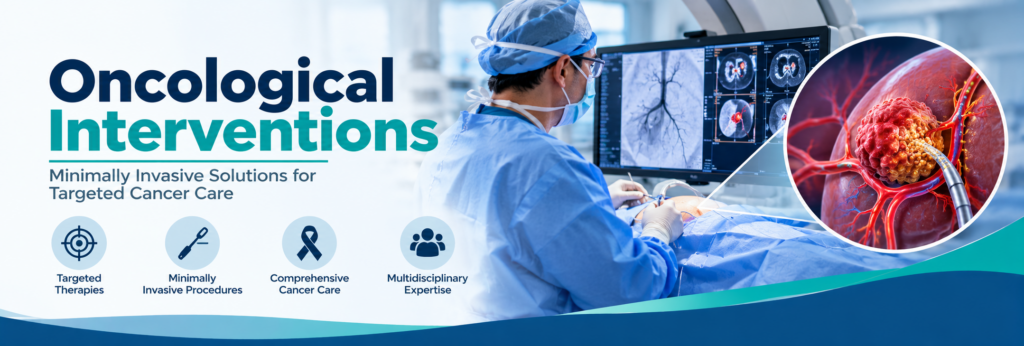
Interventional Radiology offers a range of minimally invasive, image-guided procedures for selected patients with cancer. These treatments use advanced imaging such as CT, ultrasound, fluoroscopy or angiography to accurately target tumours or the blood vessels supplying them.
Depending on the type, size, location and stage of the tumour, interventional oncology procedures may be used to treat the tumour directly, control its blood supply, reduce tumour burden or manage certain cancer-related symptoms. These procedures may be considered as an alternative to surgery in selected patients or may be combined with surgery, chemotherapy, radiotherapy and other cancer treatments.
Tumour Ablation
Tumour ablation is a minimally invasive treatment in which a needle or specialised probe is precisely positioned inside or near a tumour under image guidance. Controlled energy is then used to destroy the targeted tumour tissue while aiming to preserve surrounding healthy structures.
Depending on the clinical situation, techniques may include radiofrequency ablation (RFA), microwave ablation (MWA) or other specialised ablation methods. Ablation may be considered for selected tumours, particularly in organs such as the liver, kidney and lung, based on tumour characteristics and the patient’s overall condition.
Tumour Embolization
Tumour embolization is a catheter-based procedure that blocks selected blood vessels supplying a tumour. Through a small catheter inserted into a blood vessel, embolic material is delivered precisely to the targeted vessels.
By reducing the tumour’s blood supply, embolization may help control tumour growth or bleeding. In selected liver cancers, embolization can also be part of liver-directed therapies, including procedures such as transarterial chemoembolization (TACE) or other specialised treatments.
Image-Guided Precision
Advanced imaging allows the interventional radiologist to identify the tumour and surrounding structures and guide instruments accurately during the procedure. This precision helps target the intended area while reducing unnecessary injury to nearby healthy tissues.
The procedure performed depends on the tumour’s location, size, number of lesions, blood supply and relationship to nearby organs and blood vessels.
When May It Be Considered?
Interventional oncology procedures may be considered for selected patients:
- When surgery may not be suitable or may carry significant risk
- For patients who may benefit from a minimally invasive treatment
- For selected small or localised tumours
- For controlling certain tumours that cannot be completely removed surgically
- For controlling tumour-related bleeding or other complications
- As part of a combined treatment approach with other cancer therapies
- When local tumour control is required in carefully selected cases
Key Benefits
- Minimally invasive, image-guided treatment
- Precise targeting of selected tumour tissue or its blood supply
- Smaller access points compared with conventional open surgery
- May require a shorter recovery period in selected patients
- Can be considered for patients who may not be suitable for major surgery
- Can be combined with chemotherapy, radiotherapy, surgery or systemic cancer treatment
- Treatment can be tailored according to tumour characteristics and individual patient needs
Personalised Cancer Care
Interventional oncology is not a single treatment and is not suitable for every patient or every type of cancer. The appropriate procedure depends on the cancer type, tumour size and location, number of lesions, stage of disease, previous treatments and overall health of the patient.
Each case is evaluated individually, often as part of a multidisciplinary cancer care team involving interventional radiologists, medical oncologists, surgical oncologists, radiation oncologists and other specialists. The treatment plan is designed according to the patient’s clinical condition and overall cancer treatment strategy.
Frequently Performed Interventional Oncology Procedures
- Tumour Ablation
- Radiofrequency Ablation (RFA)
- Microwave Ablation (MWA)
- Tumour Embolization
- Transarterial Chemoembolization (TACE)
- Liver-directed embolization procedures
- Image-guided biopsy and tissue diagnosis
- Image-guided drainage of selected cancer-related collections
- Management of selected tumour-related bleeding