
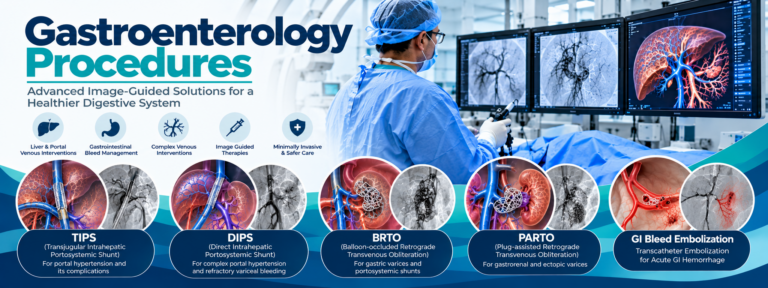
Interventional Radiology provides minimally invasive, image-guided procedures for the diagnosis and management of selected gastrointestinal conditions. These procedures use advanced imaging techniques such as ultrasound, CT, fluoroscopy and angiography to accurately access the affected area while minimising trauma to surrounding tissues.
These treatments may be considered when conventional surgery is not suitable, when a less invasive approach is preferred, or when image-guided intervention can provide effective diagnosis, drainage, bleeding control or supportive treatment. The appropriate procedure depends on the patient’s condition, imaging findings, overall health and treatment requirements.
Image-Guided Gastrointestinal Interventions
Interventional Radiology can provide a range of procedures for selected gastrointestinal conditions, including:
1. Gastrointestinal Bleeding
Image-guided angiography and embolization may be used in selected patients with active or significant gastrointestinal bleeding. A small catheter is introduced through a blood vessel and guided to the artery responsible for the bleeding.
Embolization can help block the bleeding vessel and achieve haemostasis without the need for open surgery in appropriate cases.
May be considered for:
- Upper or lower gastrointestinal bleeding
- Bleeding from selected ulcers
- Tumour-related gastrointestinal bleeding
- Post-procedural or postoperative bleeding
- Selected vascular abnormalities causing bleeding
2. Percutaneous Gastrostomy
Image-guided percutaneous gastrostomy may be performed to establish access to the stomach for nutritional support in patients who are unable to take adequate nutrition orally.
A feeding tube is placed through the abdominal wall into the stomach under imaging guidance. This can provide a reliable route for enteral nutrition in appropriately selected patients.
3. Gastrointestinal and Abdominal Drainage
Collections or abscesses within the abdomen can sometimes develop due to infection, inflammation, surgery or other gastrointestinal conditions.
Image-guided percutaneous drainage allows a catheter to be placed directly into the collection under ultrasound or CT guidance. The contents can then be drained, which may help control infection and support recovery.
Potential applications include:
- Intra-abdominal abscesses
- Postoperative collections
- Infected fluid collections
- Selected pancreatic or peripancreatic collections
- Other localised abdominal collections
4. Biliary Drainage
When a bile duct becomes blocked, bile may accumulate and cause jaundice, infection or other complications. In selected patients, percutaneous transhepatic biliary drainage (PTBD) may be performed.
Under image guidance, a catheter is inserted through the liver into the bile ducts to establish drainage. Depending on the cause and anatomy, additional procedures such as biliary stenting may also be considered.
Possible causes include:
- Bile duct obstruction
- Malignancy-related obstruction
- Benign strictures
- Selected postoperative biliary complications
- Cholangitis associated with obstruction
5. Biliary Stenting
A biliary stent may be placed to maintain bile flow through a narrowed or blocked bile duct. This can be particularly useful in selected patients with malignant or benign biliary obstruction.
The decision regarding stent placement, type and duration depends on the cause and location of the obstruction and the patient’s overall treatment plan.
6. Percutaneous Treatment of Selected Pancreatic Collections
Certain pancreatic conditions can result in fluid collections or infected collections around the pancreas. In carefully selected patients, image-guided drainage may help remove the collection and control infection.
The procedure is planned using cross-sectional imaging to determine the safest access route and relationship to surrounding organs and blood vessels.
Image-Guided Biopsy
Interventional Radiology can also provide image-guided biopsy of selected gastrointestinal, liver, pancreatic or abdominal lesions.
Using ultrasound or CT guidance, a specialised needle is precisely positioned within the target lesion to obtain tissue samples for pathological examination. This can help establish a diagnosis and guide further treatment planning.
Advantages of Image-Guided Procedures
- Minimally invasive approach
- Precise access using advanced imaging
- Small skin incision in many procedures
- Reduced tissue trauma compared with open surgery
- Can provide targeted treatment or drainage
- May be suitable for selected patients who are not candidates for major surgery
- Can be used alongside medical, surgical and oncology treatments
- Often performed with appropriate sedation and local anaesthesia, depending on the procedure
Personalised Treatment Approach
Not every gastrointestinal condition requires an interventional procedure. Treatment is selected after reviewing the patient’s symptoms, clinical history, laboratory results and imaging findings.
The Interventional Radiologist works closely with gastroenterologists, surgeons, oncologists and other specialists to determine whether an image-guided procedure is appropriate and to select the safest and most effective treatment approach.
Procedures May Include
- Gastrointestinal bleeding embolization
- Image-guided abdominal drainage
- Percutaneous gastrostomy
- Biliary drainage
- Biliary stenting
- Drainage of selected pancreatic collections
- Image-guided biopsy
- Management of selected postoperative gastrointestinal complications
- Other specialised image-guided gastrointestinal interventions
Important: The suitability of any procedure depends on the patient’s individual condition, anatomy, imaging findings and overall medical status. Each treatment is planned on an individual basis after appropriate clinical and imaging evaluation.